Five Voices, One Devotion: Inside the World of The Adulations
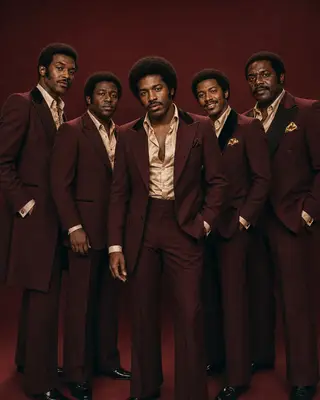
The Adulations bring commanding baritone soul, sweeping orchestration and immaculate five-man harmony into the WMG catalogue. Their music treats love not as a passing mood, but as something to be declared with urgency, dignity and complete conviction.
The Adulations do not sing as though love is something to hide.
They sing it plainly, urgently and at full scale. Their records belong to the moment when private feeling can no longer be contained: the unanswered question, the promise that needs to be renewed, the admission that pride has finally lost its argument.
At the centre of the group stands Isaiah St. James, a commanding soul vocalist whose voice can make a romantic confession feel large enough to fill a theatre. Around him are Leon Mercer, Ellis Monroe, Raymond Cole and Calvin Brooks, four distinct singers whose harmonies turn one man’s emotion into something broader and more powerful.
Together, they form WMG’s grand Philadelphia soul group: five voices gathered around one devotion.
A Voice That Means Every Word
Isaiah St. James is not a distant or delicate frontman. His voice carries warmth, weight and controlled abrasion, with the authority of someone accustomed to being heard and the vulnerability of someone who understands that authority offers no protection from love.
He can begin a song quietly, holding something back, then allow the feeling to gather until restraint is no longer possible. A line that first sounds like a request can return as a declaration. A promise can become a warning. A moment of tenderness can open suddenly into desperation.
That tension defines him: a powerful man admitting how deeply another person can affect him.
The grain in Isaiah’s voice matters, but it is never used carelessly. The rasp belongs at the emotional peak. The growl appears when ordinary phrasing will no longer carry the meaning. His strength comes not from constant volume, but from the sense that greater force is always waiting underneath.
The lead feels like fire. The group feels like the room around it.
Five Voices, Not One Singer and Four Shadows
Isaiah is unmistakably the lead, but The Adulations are a genuine vocal group. The other four members are not interchangeable figures arranged behind him.
Leon Mercer brings high-tenor brightness and natural charisma. His voice lifts the top of the harmony, while his presence gives the group warmth and polish.
Ellis Monroe occupies the heart of the blend. Calm and understated, he supplies the smooth inner harmony that keeps the group full without making it heavy.
Raymond Cole adds tension. His baritenor responses bring rhythmic definition and a touch of theatre, particularly when a song moves from romantic uncertainty towards confrontation.
Calvin Brooks provides the foundation. He is a light baritone rather than a deep bass, grounding the group with maturity and weight without pulling the sound towards doo-wop or gospel-quartet caricature.
Their voices do not sit beneath Isaiah continuously. They arrive when the song needs them: a whispered answer, a repeated word, an “ooh” held behind a confession, or the sudden entrance of all five men as the chorus opens out.
That gradual gathering is central to the group’s sound. Isaiah begins with the feeling. The others reveal its scale.
Philadelphia Soul at Full Scale
The Adulations live in the grander, more orchestrally ambitious world of early-1970s Philadelphia soul.
Their arrangements are built around warm electric piano, melodic bass guitar, clipped rhythm guitar and drums that remain precise without becoming mechanical. Tambourine, congas and vibraphone add movement and colour. Horns appear with restraint, offering punctuation rather than turning the songs into brass-led performances.
Then come the strings.
They rise beneath Isaiah’s phrasing, answer the vocal line and widen the emotional space around the group. At their best, the strings do not simply make the music sound romantic. They tell us when the feeling has become too large for the rhythm section to hold alone.
The production should feel rich, but never crowded. Every swell, pause and harmony entrance has a purpose. A rhythmic break might leave Isaiah exposed for a single line. A restrained verse might give way to a chorus in which all five voices and the full string arrangement arrive together.
This is not nostalgia recreated for display. It is a musical language being used because it suits the group’s emotional scale.
Love That Does Not Whisper
The Adulations return repeatedly to desire, loyalty, promises, jealousy, reconciliation and the cost of withholding the truth.
Their songs are often addressed directly to another person. Isaiah is not usually reflecting from a safe distance. He is standing at the door, waiting beside the telephone or looking across the room at someone who must make a decision.
There is dignity in these songs, but not emotional avoidance. The group’s idea of masculinity allows for need, tenderness and uncertainty. Isaiah may be proud, but he is strong enough to say when he wants someone to stay. He may be wounded, but he does not disguise heartbreak as indifference.
Even their most sensual music should feel emotionally serious. Closeness is not treated as conquest. It is connected to trust, commitment and the desire to be chosen completely.
Their defining subject is not simply romance.
It is what romance demands of a person once the easy words are no longer enough.
Burgundy, Champagne and Amber Light
Visually, The Adulations belong to Philadelphia between approximately 1971 and 1974.
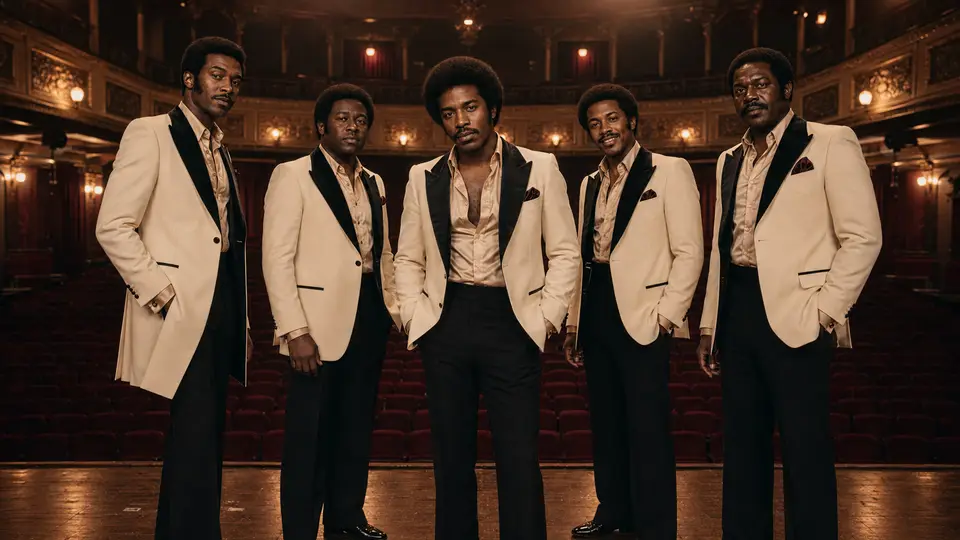
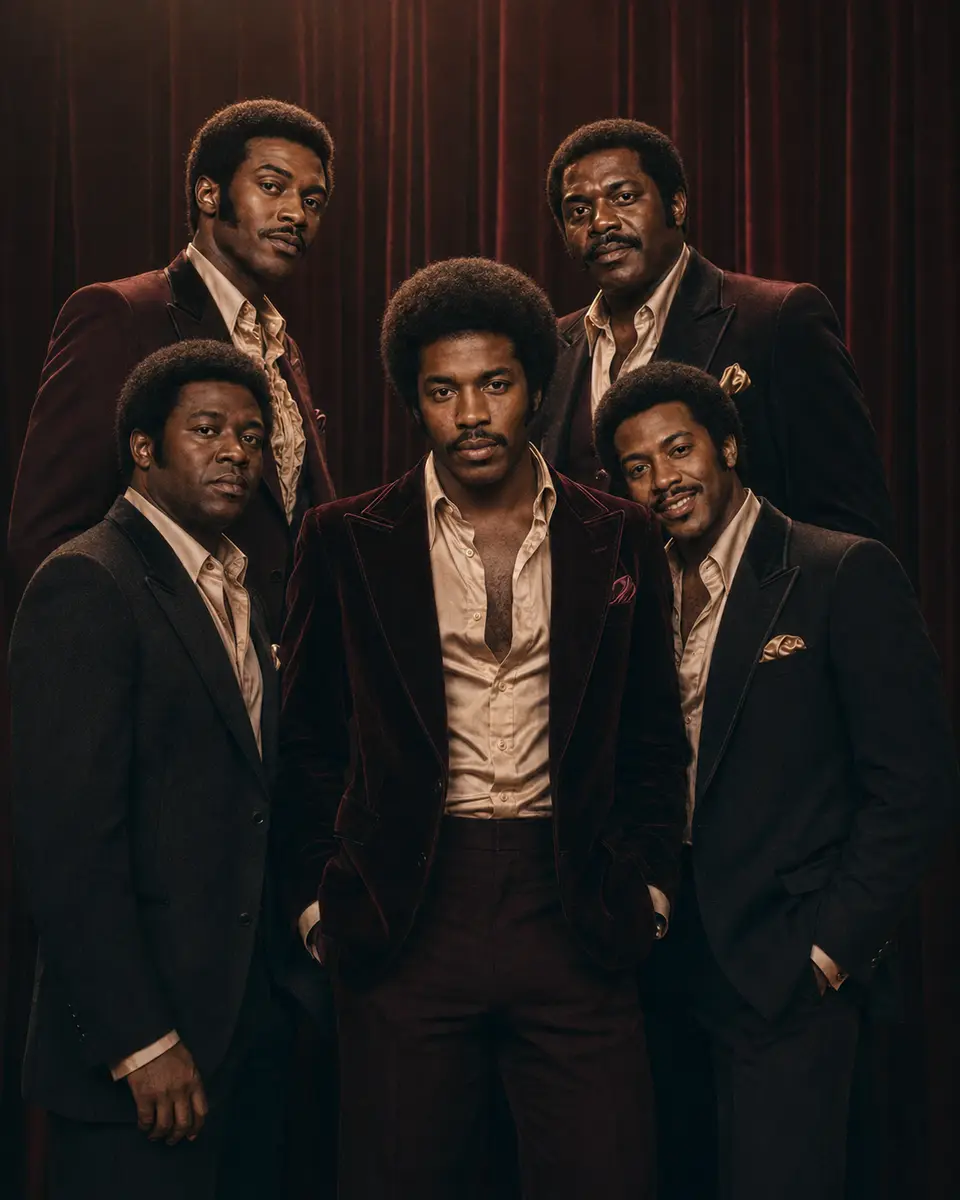
Their world is made from burgundy velvet, polished dark wood, cream stone, antique-gold details and the pools of amber light found in old theatres after the audience has gone home. They appear in formal studios, backstage corridors, empty auditoriums and on city rooftops at dusk.
Their tailoring is coordinated rather than identical. Oxblood, midnight navy, aubergine, black and champagne create a unified palette, while small differences in cut and detail preserve each member’s character.
Isaiah occupies the centre in the most commanding variation of the group look. Leon is the sharpest and most polished. Ellis remains deliberately understated. Raymond’s longer, cleaner lines emphasise his elegant silhouette. Calvin wears the most structured and traditional tailoring.
Nothing should feel like costume. The clothes, settings and photography establish a period, but the men themselves must remain believable.
How to Hear The Adulations
The first thing to notice is the contrast between Isaiah and the surrounding voices.
Listen for how a verse begins with space around him, then gradually fills. Notice when Leon’s tenor adds light above the lead, when Ellis warms the centre, when Raymond introduces urgency and when Calvin gives a final phrase greater weight.
Then listen to the arrangement itself. The strings rarely enter without reason. The rhythm section remains disciplined, leaving space for a pause, a spoken-sung phrase or a sudden group answer.
Finally, listen to the emotional movement. An Adulations song should rarely remain in the same place from beginning to end. It gathers. What begins as restraint becomes admission, then demand, promise or release.
Their catalogue may move between slow-burning ballads, relationship ultimatums, reconciliations and sophisticated uptempo soul, but the essential character remains constant.
Love is being taken seriously.
The Adulations at WMG
The Adulations occupy a clear place within Wareham Music Group.
Betty Blane brings classic female soul elegance. Bobby Chills inhabits the shadowed rooms of blues-soul regret. The Verities offer the lighter, falsetto-led tradition of 1960s sweet soul. Spencer Laurent brings warmth, optimism and modern romantic ease.
The Adulations bring masculine intensity, orchestral grandeur and adult emotional confrontation.
They are the group for love songs that do not whisper.
Their presence expands the WMG soul catalogue without repeating another artist’s role. They offer the discipline of a vocal group, the force of a commanding frontman and a visual world capable of carrying romance at its most serious and cinematic.
What Comes Next
The possibilities within The Adulations are broad, but their centre must remain firm.
They can move from private slow-burn intimacy to sweeping heartbreak, from tense relationship songs to brighter declarations of commitment. They can sing about pride, waiting, forgiveness and the frightening honesty of needing another person.
Whatever direction the music takes, it should continue to return to the same essential idea: strength does not disappear when a man admits that love has power over him.
For The Adulations, that admission is where the song truly begins.
Summary
The Adulations are WMG’s five-man Philadelphia soul powerhouse, built around Isaiah St. James’ commanding baritone voice, disciplined male harmony and sweeping early-1970s orchestration. Their world combines romantic urgency, masculine vulnerability and visual elegance, turning desire, loyalty and heartbreak into declarations delivered with absolute conviction.
Related